



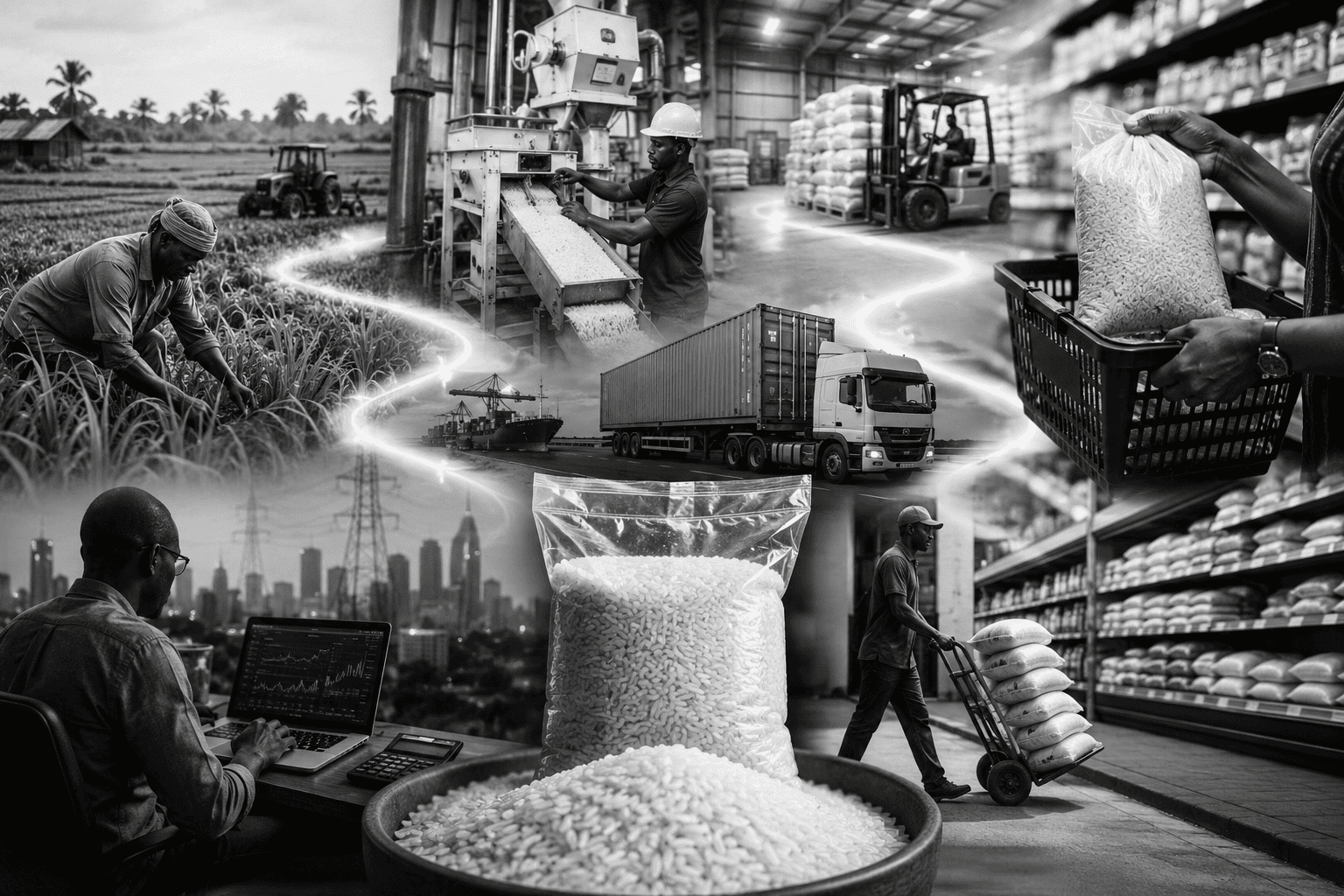
The Journey of a Bag of Rice
SEID Intel by Oluwatoyin
A few days ago, I was putting away groceries when a bag of rice sitting in the corner caught my eye.
I suddenly realised I’d never really stopped to think about how much had to happen before it reached my kitchen.
Not just the farming.
Everything else.
Long before it found its way into my shopping basket, someone had processed it. Someone had produced the packaging. Someone had transported it across cities. Someone had stocked it on a supermarket shelf. Somewhere along the line, banks, payment platforms, warehouses and electricity had quietly played their part too.
It struck me that what looked like an ordinary grocery item was actually the result of dozens of businesses, across different industries, all doing their jobs.
We often talk about agriculture, manufacturing, finance, logistics, energy and technology as though they’re separate conversations. But they’re not. They’re all connected.
A farmer needs access to finance before the first seed is planted. Manufacturers rely on stable power to keep production running. Transporters connect producers to markets. Retailers depend on efficient logistics to keep their shelves stocked, while technology and payment platforms make every transaction possible. When one part slows down, the effects don’t stay there. Delays become higher costs. Higher costs become higher prices. Before long, everyone in the chain feels the impact.
It’s easy to miss because, as customers, we only see the finished product.
Businesses don’t have that luxury.
They experience the entire journey.
And perhaps that’s why manufacturing is about much more than what happens inside a factory.
A factory can only be as efficient as the value chain supporting it. When producers, transporters, energy providers, financial institutions, technology platforms and manufacturers work well together, businesses spend less time dealing with delays and less money fixing inefficiencies. Production becomes faster, operating costs reduce and products reach the market at more competitive prices. Businesses become more productive, consumers benefit from better value and the economy becomes more attractive to investment.
That’s where Nigeria’s opportunity lies.
With one of Africa’s largest populations, Nigeria already has something many countries spend decades trying to build: demand. Countries like China and India have shown how large populations, backed by efficient manufacturing ecosystems and well-connected value chains, can become powerful drivers of industrial growth. Nigeria’s journey will be different, but the lesson is just as relevant. A large population creates demand, but efficient value chains turn that demand into industrial growth.
If we can strengthen the links between agriculture, manufacturing, logistics, finance, energy and technology, we won’t simply move goods more efficiently. We’ll lower the cost of doing business, improve the competitiveness of locally made products and create the kind of environment where manufacturers can grow with confidence. That is how countries become manufacturing hubs, not through one successful factory, but through systems that allow thousands of businesses to succeed together.
Looking beyond the obvious is part of how we think at SEID. We pay attention to the opportunities that exist beyond individual businesses, where stronger value chains can unlock growth, improve competitiveness and create long-term value. These, and many more insights shaping Nigeria’s manufacturing landscape, will be explored in our upcoming Manufacturing Report.
Maybe that’s the bigger lesson behind a bag of rice.
It isn’t really about the rice.
It’s about what happens when different parts of an economy work well together, so well that most of us never stop to think about everything it took to get that one bag onto a supermarket shelf.
Interestingly, while reflecting on this, I came across a headline that couldn’t have been more timely.
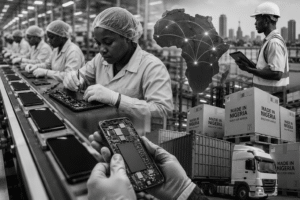
ALTON backs NCC’s push for local smartphone manufacturing, says it’ll deepen digital inclusion
The Association of Licensed Telecommunications Operators of Nigeria (ALTON) has backed the Nigerian Communications Commission’s (NCC) call for local smartphone manufacturing, saying it could accelerate broadband adoption and deepen digital inclusion.
ALTON believes the opportunity goes beyond assembling phones. It says building stronger local manufacturing capabilities, improving quality standards, expanding affordable smartphone financing and connecting the right partners across the value chain can help Nigeria produce not just for itself, but for Africa. The association also highlighted Nigeria’s large population as a key advantage, arguing that with the right ecosystem in place, the country has the potential to become a competitive technology manufacturing hub.
Here are a few other headlines that also caught my attention this week:
CPPE: Textile import ban will create supply shortages, increase production costs. Pull one thread, and the bigger picture starts to unfold.
ALERT: FG warns Nigerian banks of ATM cyber attacks after $2m Senegal heist. As technology evolves, so do the risks. Just leaving that here.
FG launches AI scaling hub with $7.5m Gates Foundation support.The AI plot thickens.
CBN seeks stronger cross-border payment systems to boost African trade. Even money prefers direct flights.
FG announces discovery of platinum, lithium deposits in Kaduna. Kaduna really said, “Check the basement.”
ACCI to FG: Ensure tax reforms don’t kill businesses as Nigeria targets $1trn economy.A gentle reminder that businesses can only pay taxes if they’re still in business.
African businesses need access, collaboration to thrive globally, says Landmark CEO.Apparently, “we rise by lifting others” has entered the boardroom.
IMF: Nigeria accounts for 60% of stablecoin inflows in sub-Saharan Africa. Who needs a suitcase when you’ve got a stablecoin?
CBN: Nigeria’s balance of payments surplus dropped to $2.38bn in Q1 | Fuel imports down 87%. The numbers have been busy.
Mastercard says 81% of Nigerian SMEs expect growth in the next 12 months. The business is still businessing.
Just leaving that here.