




Beyond the Hustle: Building Businesses That Build Economies
SEID Intel by Oluwatoyin
Somewhere in Nigeria, someone is turning a skill into a business. It could be a woman who started selling pastries to friends and now supplies offices, a young entrepreneur whose online clothing store is reaching customers in different cities, or a small manufacturer trying to keep up with growing demand. What starts as a modest venture often comes with a much bigger ambition: to grow, employ others and reach beyond its first customers.
Nigeria certainly has the numbers to tell an impressive business story. According to the 2020 National Survey of Micro, Small and Medium Enterprises (MSMEs), conducted by SMEDAN and the National Bureau of Statistics, the country had approximately 39.7 million MSMEs. Together, they contributed 46.32% to GDP and accounted for 87.9% of employment. That is a huge part of the economy, powered by businesses that are often working with limited resources but carrying considerable potential.
Germany offers an interesting example of what happens when smaller businesses become deeply connected to a country’s industrial growth. Its small and medium-sized enterprises account for 99.2% of all businesses and employ about 54.4% of its workforce. Many are involved in specialised manufacturing, producing machinery, engineering components and other products used by major companies at home and abroad. They are not necessarily household names, but they play an important role in keeping industries running and German products competitive.
A big part of this success comes from how Germany develops its workforce. Businesses are actively involved in vocational training, allowing young people to learn practical skills while gaining experience on the job. In 2024, companies with fewer than 250 employees trained more than 68% of the country’s apprentices. This means smaller businesses have a role not only in creating jobs, but also in developing the skilled people needed to keep their industries growing.
For many Nigerian business owners, the reality can look quite different. A manufacturer may have enough orders to expand but struggle with the cost of machinery, unreliable electricity and expensive loans. A food processing business may be ready to supply supermarkets but lack the certifications, storage facilities or distribution network to get its products there. Sometimes, the customers are available and the ambition is there, but the cost of taking that next step is simply too high.
Singapore has taken a practical approach to helping smaller businesses overcome some of these barriers by connecting them with larger companies. Through programmes involving multinational corporations and established local enterprises, SMEs get opportunities to improve their capabilities, adopt technology and become suppliers within wider business networks. Rather than leaving smaller companies to find customers and opportunities on their own, these partnerships bring them closer to the markets they want to serve.
There is room for more of these relationships in Nigeria. Large companies in oil and gas, manufacturing, agriculture and construction all need equipment, packaging, logistics, maintenance and other services. More Nigerian businesses could meet these needs if they had access to the right financing, technical training, technology and quality certifications. This would give smaller companies a chance to secure bigger contracts while helping larger businesses source more goods and services locally.
The economic impact could extend well beyond individual businesses. As companies expand, they create jobs, purchase more raw materials, engage suppliers and increase local production. A growing food processor, for instance, creates opportunities for farmers, transporters, packaging companies and distributors. One business’s expansion can support an entire network of others.
Nigeria already has the entrepreneurs and the willingness to build. What needs greater attention is the environment that allows those businesses to move beyond their immediate markets. Access to affordable finance, reliable power, practical skills, technology and stronger links to larger industries can determine whether a small business remains where it started or grows into a significant employer and producer.
The next major Nigerian company could already exist as a small business somewhere today. It may be a local manufacturer, a food processor or a specialist supplier with the ambition to serve a much bigger market. When businesses get the opportunity to grow, the benefits go beyond their owners, strengthening industries, creating jobs and adding value to the wider economy.
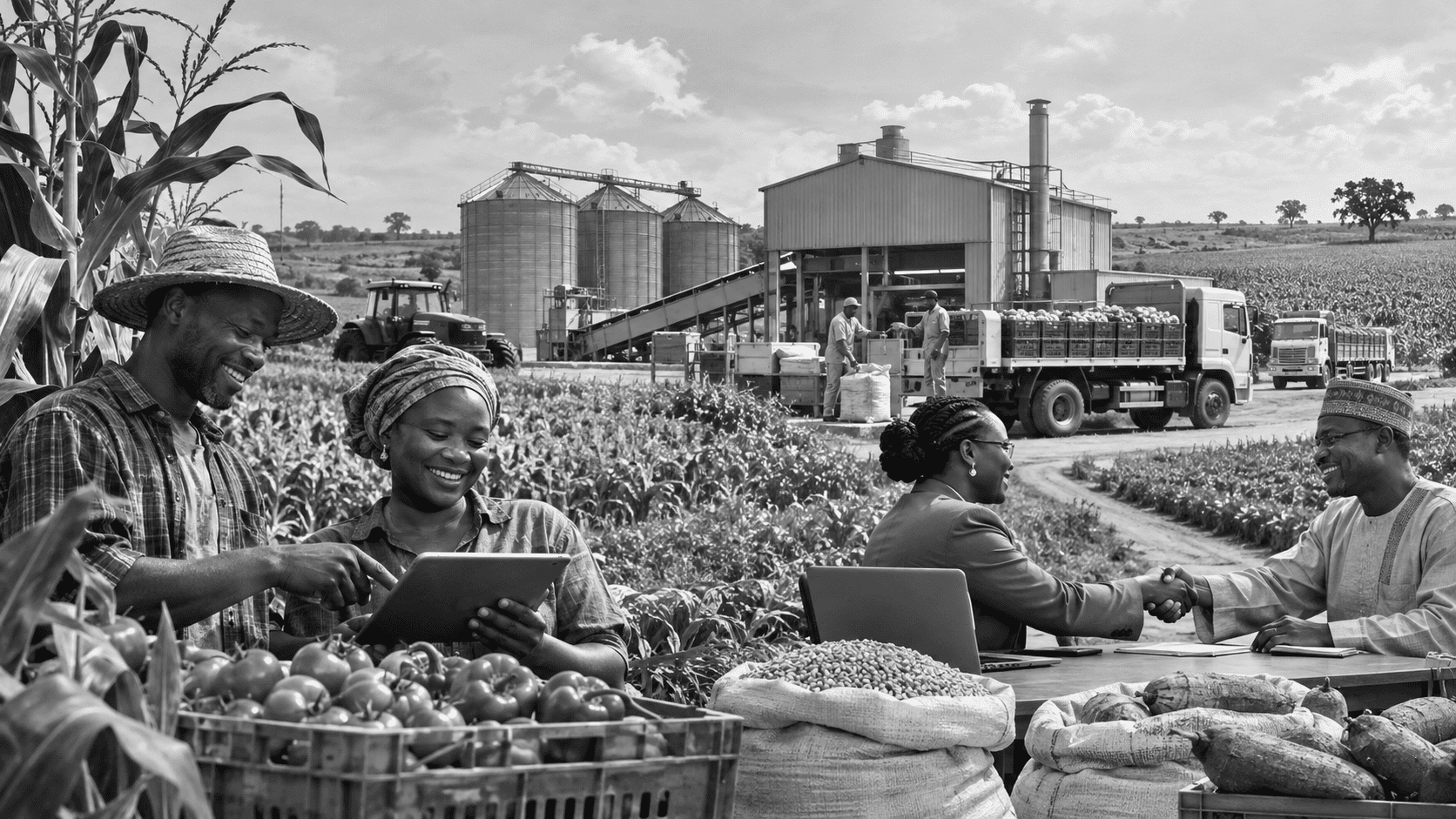
On the subject of giving businesses the support they need to grow, I spotted another interesting development in the news
NADF, firm sign MoU to lower financing costs for agribusinesses
For many agribusinesses in Nigeria, the cost of borrowing can be as challenging as the business itself. Interest rates of between 24% and 27% are common for some small and medium-sized operators, leaving little room to invest in expansion after meeting the cost of financing. A new partnership between the National Agricultural Development Fund (NADF) and Sahel Capital Fund Manager Limited is looking to ease some of that pressure.
The two institutions have signed a memorandum of understanding (MoU) to improve access to more affordable financing for agribusinesses. Under the arrangement, NADF will provide capital alongside Sahel Capital, with the aim of reducing borrowing costs for eligible businesses. The idea is straightforward: when businesses spend less on interest payments, they have more room to invest in production, improve operations and grow.
The partnership will also look beyond the immediate question of funding. Both institutions plan to identify challenges across agricultural value chains and develop targeted interventions to address them. NADF brings its development mandate and understanding of national agricultural priorities, while Sahel Capital contributes its investment experience across the continent. The firm has made 45 investments in eight African countries over the past 15 years.
For NADF, the agreement represents an opportunity to move beyond conventional agricultural lending and help build an investment ecosystem capable of attracting more private and institutional capital into the sector. Its Executive Secretary, Muhammed Ibrahim, described the partnership as part of that broader shift. If it delivers on its objectives, the arrangement could give agribusinesses more affordable financing while helping strengthen investment across Nigeria’s agricultural value chains.
Here are a few other headlines that also caught my attention this week:
- IN DETAIL: Financial services, agricultural sectors drive N110bn NGX turnover. Banking and agriculture were doing the heavy lifting on the NGX.
- Refinery IPO didn’t hit 10m investors target, says Dangote. The target was 10 million investors. The appetite was certainly there.
- Enugu Air to begin Lagos-London flights December 10. Enugu to London? December just got a new departure point.
- PHOTOS: FG expands CNG network with new refuelling station in Abuja. Abuja just got another reason to give petrol a break.
- NADF, firm sign MoU to lower financing costs for agribusinesses. Growing food is one thing. Financing the business behind it is another.
- World Bank: Developing countries’ external debt rose 5.5% to $9.4trn in 2025. Borrow today, repay tomorrow. Except tomorrow’s bill keeps getting bigger.
- Dantsoho: FG can’t fund ports expansion alone; private investment needed. Nigeria’s ports are getting busier. The infrastructure needs to keep up.
- Lagos asks cooperatives to invest in real estate, says it could address housing needs. Real estate is no longer just a developer’s game. Cooperatives want in.
- Customs begins evacuation of 98 containers of power equipment trapped for 14 years. Some deliveries take longer than expected. This one took 14 years.
- ALTON, telcos sue reps over service quality probe summons, threat to arrest CEOs. The telcos have taken the conversation from poor signals to legal signals.
Just leaving that here.