

What Telecoms Really Powers
SEID Intel by Oluwatoyin
You don’t realise how much of your life runs online until the network stops.
The transfer hangs. The POS stops responding. Your ride cannot locate you. The virtual meeting freezes. What looks like a small connectivity problem can suddenly stop a transaction, delay a sale or bring work to a standstill.
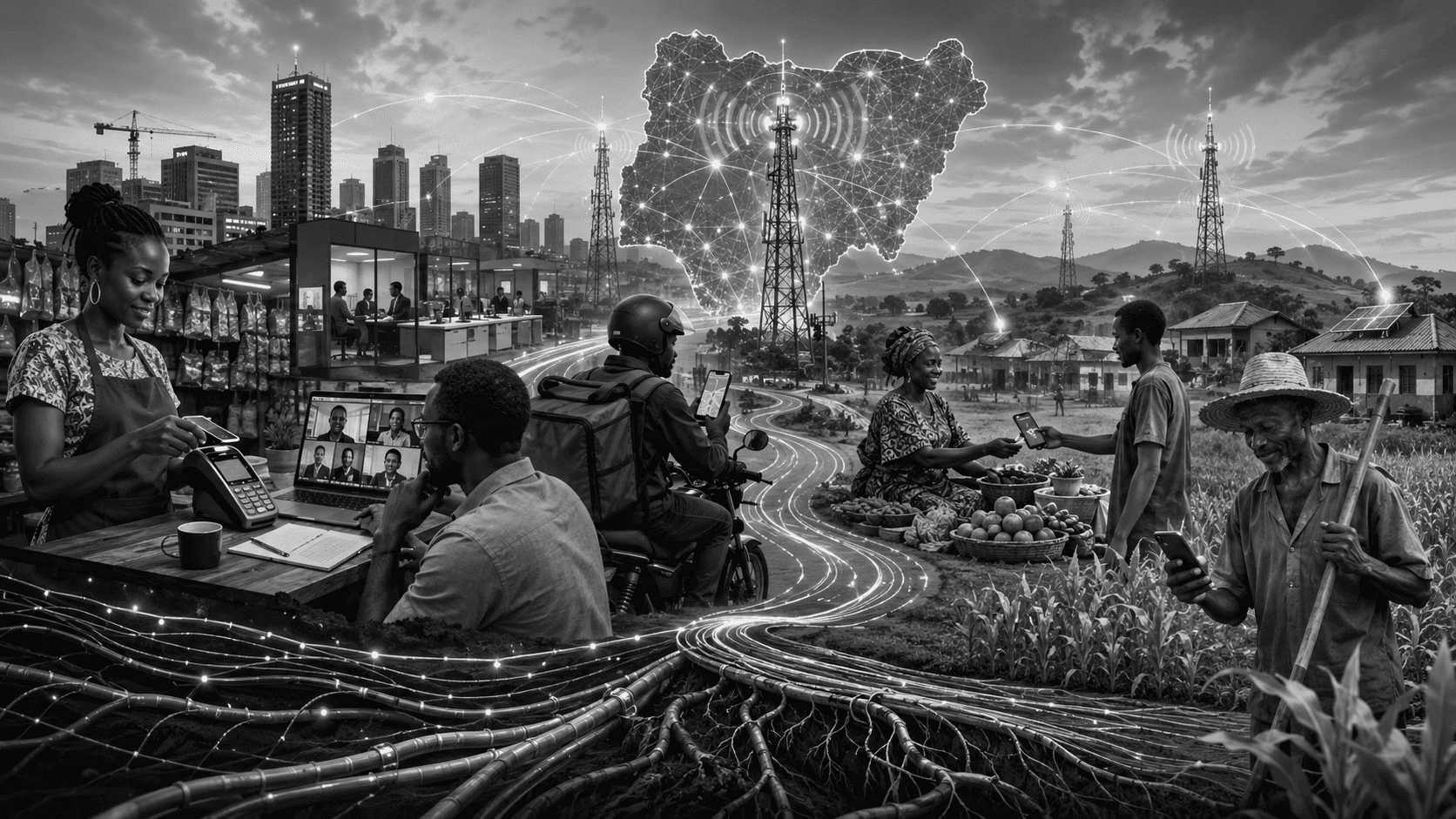
At SEID, we spend a lot of time thinking about what actually enables industries to grow. Telecoms is an interesting one because its value goes far beyond calls and data. Increasingly, it is the infrastructure underneath how other businesses operate.
Telecommunications and information services contributed about 9.19% of Nigeria’s real GDP in Q1 2026, while the segment grew by 12.24% year-on-year, well ahead of overall GDP growth.
But the more interesting story is what sits behind that number.
Before the fintech processes a payment, before the e-commerce platform takes an order, before a business serves a customer online, there is a network.
Telecoms works a little like roads. A road does not sell the goods in a market, but it determines how easily people and products can reach it. Connectivity does something similar for the digital economy.
That is why plans to deploy about 3,700 additional telecom towers, potentially extending connectivity to more than 20 million Nigerians, are worth paying attention to if successfully implemented.
The real question is not the number of towers.
It is what becomes possible when millions more people become easier to reach.
Banks can serve customers without building branches everywhere. Retailers can sell beyond major cities. Farmers and small businesses can access payments, buyers and information more easily. Fintech, insurance, healthtech, education and entertainment businesses potentially gain a much wider market.
In simple terms, connectivity reduces the cost of distance.
But there is an important catch.
Mobile broadband coverage already reaches roughly 89% of Nigerians, yet only about 31% of the population was using mobile internet in 2024. Smartphone ownership was also just 27%.
So the challenge is not only getting network coverage to people. It is getting people to actually use it.
In rural Nigeria, for example, 90% of adults surveyed owned a mobile phone, but only 39% owned an internet-enabled device and just 28% used mobile internet.
That gap matters.
A tower can provide coverage, but affordability, reliable power, data costs, device access and quality of service determine whether that coverage becomes useful.
And for businesses, that is the real lesson.
Nigeria’s next digital market will not be defined only by where the network reaches.
It will be defined by where people can afford to connect, stay connected and meaningfully participate.
Because when coverage becomes regular usage, and regular usage becomes transactions, work, learning and commerce, telecoms stops being just a communications sector.
It becomes infrastructure for the rest of the economy.
On the subject of what keeps economies moving, this was one of the more interesting stories in the news recently.
Nigeria’s clean energy attracting more investments than gas power projects
Nigeria’s clean energy sector is drawing growing investor interest, even as gas-fired power projects struggle to attract new capital. BudgIT Foundation says Nigeria was the world’s fifth-largest recipient of international public finance for clean energy in 2023, with $829 million committed to 42 projects, and became the 10th-largest recipient of foreign investment for renewable energy in 2024. Nigerian firms also received about a fifth of all African mini-grid financing between 2019 and 2023.
The contrast with gas power is striking. Despite Nigeria’s heavy reliance on gas-fired generation, BudgIT says almost no new capital flowed into Nigerian gas power during the period covered by the study. At the same time, global clean-energy investment grew tenfold between 2019 and 2024, suggesting that the competition for energy capital is increasingly shifting towards renewable projects.
There is still a much bigger financing challenge ahead. Nigeria’s energy transition plan estimates that achieving net-zero emissions by 2060 will require about $1.9 trillion, with roughly $410 billion needed above business-as-usual spending. The issue, however, is not simply attracting interest. Investors still need bankable projects, regulatory certainty, reliable financial models and mechanisms to manage risk before capital can move from announcements into actual power projects.
Here are a few other headlines that also caught my attention this week:
- CPPE: Economic reforms entering growth phase, reversal could hurt investor confidence, FX market. The economy says “don’t touch anything.”
- SEC proposes N30m registration fee, N2bn capital requirement for digital asset providers. SEC said “innovate responsibly”… and come with capital.
- REA secures N50bn credit facility for renewable energy developers. Rural electrification just got a serious power bank.
- PwC: FDI accounted for only 1.3% of Nigeria’s $10.3bn capital inflows in Q1. Foreign capital came in strong. FDI came in shy.
- FAAN says no prohibition of Uber, Bolt operations at airports. FAAN said relax, your airport ride is still coming.
- Shippers’ council now ports economic regulator under new NPERA Act. Nigeria’s ports are getting a new rulebook.
- FCCPC warns manufacturers, retailers against sale of products with misleading labels. If it’s not inside, don’t put it on the outside.
- FG inaugurates upgraded Lagos substations, boosts national grid by 272MW. 272MW added. Now the sockets have expectations.
- US lifts 12-year restriction on vessels calling at Nigerian ports. Twelve years later, Nigerian ports are off the watchlist.
- Meta, FG launch AI Academy to expand access to artificial intelligence training. Nigeria said if AI is the future, we might as well study for it.
Just leaving that here.