



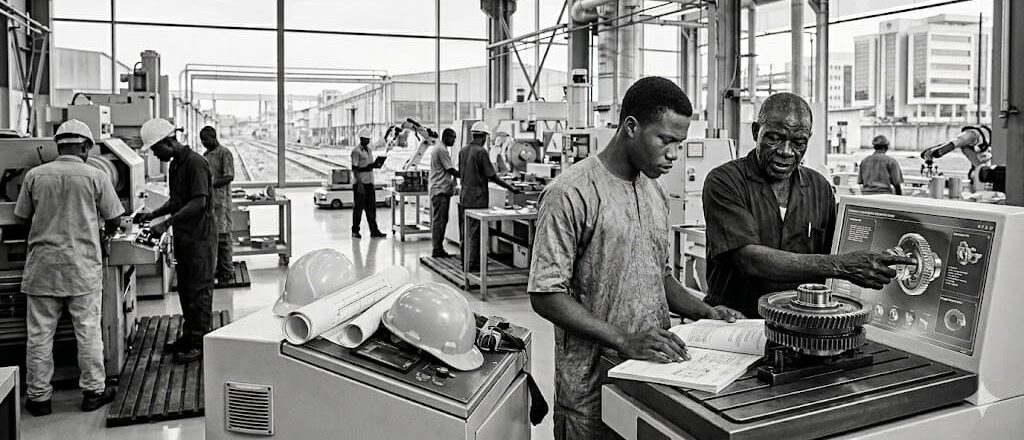
The Human Capital Challenge in the Manufacturing Sector
SEID Intel by Oluwatoyin
Every day, millions of Nigerians use products that were manufactured, packaged, assembled, or processed by someone they might never meet. From the bread we eat in the morning and the water we drink, to the products we use daily, they all pass through the hands of people working behind the scenes to keep production moving.
While manufacturing plays a vital role in everyday life, careers within the sector are often overlooked.
For many young people exploring career options, manufacturing is not always among the first sectors that come to mind. Yet these are the people responsible for keeping production lines running, maintaining equipment, and ensuring factories can meet demand.
As Nigeria pushes for greater industrialisation and local production, it raises an important question: Do we have enough skilled talent to support this ambition?
At SEID, these are conversations we find ourselves having quite often. While working on our forthcoming Manufacturing Sector Report, one issue keeps coming up: the challenge of skilled talent in the manufacturing sector.
For many manufacturers, the challenge is not simply finding workers. It is finding workers with the right skills.
One thing that comes up repeatedly is the gap between what many young people learn in school and what employers need on the factory floor. While theoretical knowledge remains important, manufacturers are increasingly looking for practical, hands-on skills that can be applied in real-world settings. This is why stronger links between industry and education, along with more industry-aligned curricula, have become such an important part of the conversation.
Then there is the issue of growth. When people consider a career path, they naturally want to know where it can lead. Many supervisors, plant managers, and business leaders started their careers on the factory floor, but those success stories are not always visible. Creating clearer career pathways can help people see technical and manufacturing roles not just as jobs, but as careers with room to grow.
Pay also matters. Technical skills are developed over time and play a critical role in keeping production running efficiently. As demand for these skills grows, compensation and incentives need to reflect the value they bring.
What often gets less attention is the opportunity for innovation. The people working closest to machines and production processes are usually the first to spot inefficiencies, identify gaps, and suggest improvements. In many cases, some of the most practical innovations begin on the factory floor.
Countries with strong manufacturing sectors understand that industrial growth and workforce development go hand in hand. China, for example, has invested heavily in vocational education and technical training, helping to build a workforce that can support its industrial ambitions.
Nigeria has the same opportunity. Stronger collaboration between manufacturers, technical colleges, vocational institutions, and schools can help equip more young people with practical, industry-relevant skills while supporting the long-term growth of the sector.
The stakes extend far beyond individual factories. When skilled talent is in short supply, productivity suffers, costs increase, expansion slows, and competitiveness weakens.
We often talk about infrastructure, financing, and policy reforms when discussing manufacturing. Those conversations are important. But so are the people behind the machines.
Factories may be built with steel and machinery, but their success ultimately depends on people. If Nigeria is serious about becoming a manufacturing hub, investing in human capital must be treated with the same urgency as investing in infrastructure, technology, and production capacity.
Speaking of growth and development, I recently came across CPPE’s assessment of Nigeria’s first-quarter GDP performance.

CPPE: Nigeria’s Economy on Gradual Recovery Path, but Structural Gaps Persist
Nigeria’s economy grew by 3.89% in Q1 2026, compared to 3.13% in the corresponding period of 2025, according to data from the National Bureau of Statistics (NBS). While slightly below the 4.0% recorded in Q4 2025, the Centre for the Promotion of Private Enterprise (CPPE) noted that first-quarter growth is typically influenced by seasonal factors.
The services sector remained the main driver of growth, contributing 57.73% to GDP, while trade emerged as the largest contributor at 17.89%. The oil refining sector recorded the strongest growth during the quarter at 37.46%, largely driven by the impact of the Dangote Refinery.
Manufacturing also improved, growing by 3.29% from 1.13% in the previous quarter. However, CPPE noted that high energy costs, elevated interest rates, and logistics bottlenecks continue to weigh on the sector’s performance.
The think tank identified the electricity and gas sector as a key concern after it contracted by 15.30% during the quarter. According to CPPE, addressing structural challenges in the power sector will be critical to sustaining economic growth, improving productivity, and supporting industrial development.
Here are a few other headlines that also caught my attention this week:
- Budget office: FG spent N3.41trn on debt servicing in Q3 2025 — 4.8% below projection. Slightly lower than expected. Noted.
- Disruption looms in the financial sector as payment firms threaten to suspend Verve transactions. The real transaction being processed here is the drama.
- Airlines crack down on power banks over growing safety risks. Airlines would like your phone charged, just not that charged.
- Air Peace begins Lagos-Barbados direct flights. One flight closer to turning “I need a vacation” into action.
- Grenada PM calls for stronger Africa-Caribbean ties in trade and investment. The conversation is moving from heritage to partnerships.
- The Nigerian Railway Corporation (NRC) has announced the temporary suspension of the Warri-Itakpe train service (WITS) over operational exigencies and technical advice from engineers. A brief stop, so future stops remain brief.
- CBN: Foreign portfolio inflows surged to $3.37bn in January — up by 258%. Foreign investors clocked in.
- Cost of healthy diet rises to N1,541 daily in March 2026 — NBS. Healthy eating remains committed to testing everyone’s budget.
- Federal workers reject proposed N100,000 minimum wage, demand living wage. For many workers, the debate is about survival, not salaries.
- Power outages cost Nigerian firms 3% of annual sales—AfDB report. Nigeria’s generators remain fully employed.
Just leaving that here.